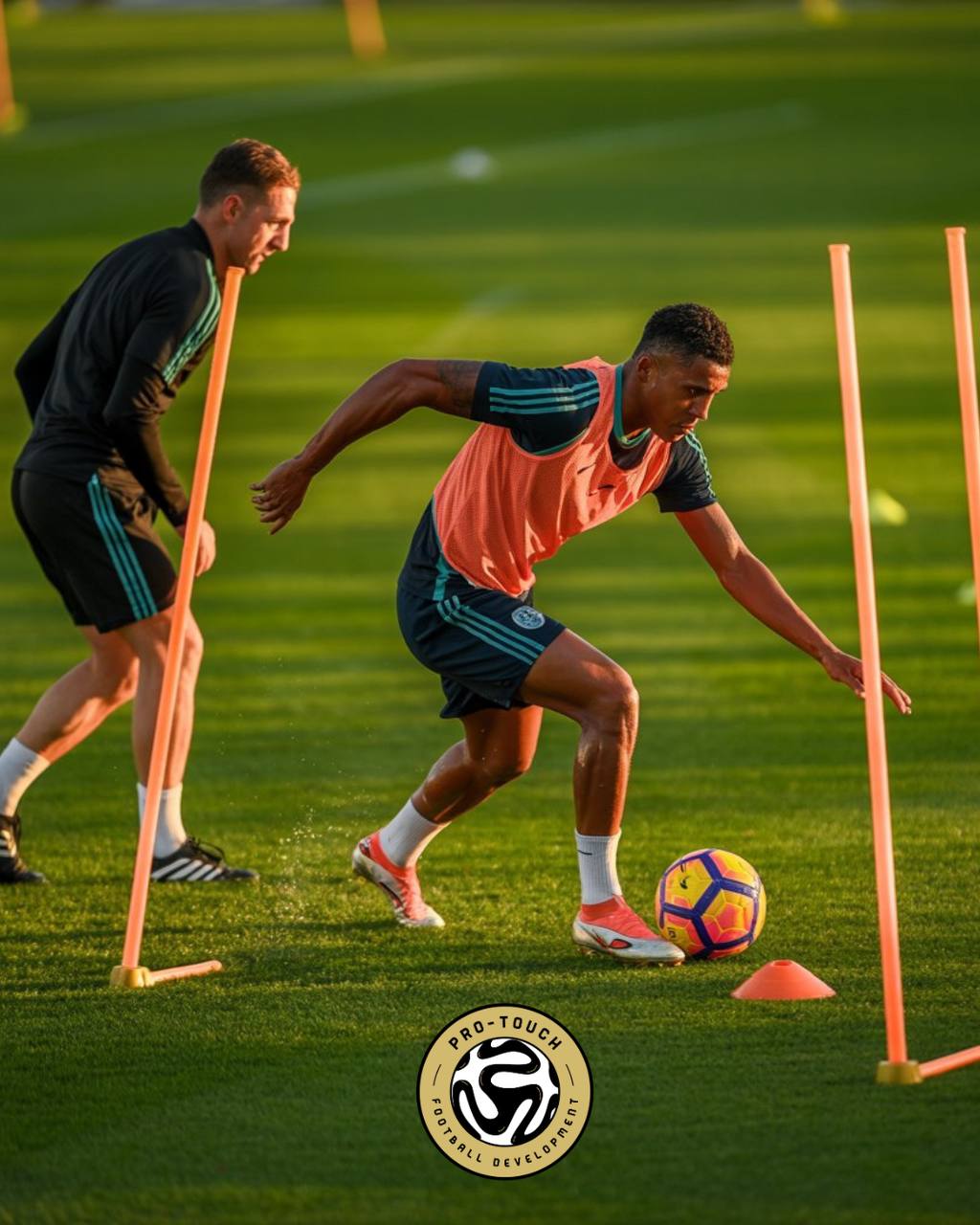
By Pro Touch Football | 1-to-1 Football Development Coaching
What separates a good footballer from a great one? The answer is rarely the spectacular the flashy dribble or the long-range strike. More often, it comes down to something far more fundamental: movement.
Whether you are a youth player learning the game, an amateur looking to step up, or an aspiring professional trying to catch a coach’s eye, understanding key movements on and off the ball is one of the most important things you can develop. In this guide, we break down exactly what those movements are, why they matter, and how to start building them into your game today.
Modern football demands complete players, players who are intelligent without the ball, decisive with it, and constantly thinking one step ahead. This guide covers both sides of that equation.
What Is Movement in Football — and Why Does It Matter?
Movement in football refers to the deliberate, purposeful actions a player makes in relation to teammates, opponents, the ball, and the space on the pitch. It includes every run, shift of body weight, change of direction, and positional adjustment a player makes throughout a match.
The average outfield player runs between 10 and 13 kilometres in a 90-minute match. But the distance you cover matters far less than the quality of the movement within it. Elite players like Kevin De Bruyne, Lautaro Martinez, and Bukayo Saka are not necessarily the fastest players on the pitch but their movement is relentlessly intelligent. They are always in the right place at the right time because they have mastered the principles of movement.
Movement in football falls into two broad categories:
- On-Ball Movement — How you move and act when you are in possession
- Off-Ball Movement — How you position and move when you do not have the ball
Both are equally important. A player who is brilliant on the ball but static without it will always be limited. Equally, a player who makes excellent runs but cannot control possession when it arrives will consistently waste the opportunities they create. The complete modern footballer masters both.
Key On-Ball Movements Every Footballer Must Master
When you receive the ball, the quality of what happens in the next two to three seconds is determined almost entirely by the preparation that came before it. On-ball movement is about far more than what you do with the ball it is about how you set yourself up to receive, control, and use it.
1. The Open Body Shape
Your body shape when receiving the ball dictates your options. An open body shape ,standing half-turned so you can see as much of the pitch as possible allows you to scan both sides before the ball arrives, take a first touch in any direction, and make quicker, better decisions under pressure.
How to practise it:
- Before receiving, check your shoulder and position your hips at an angle to the ball
- Identify at least one passing option before the ball reaches you
- In rondos and small-sided games, challenge yourself to play with two touches maximum to force better preparation
Players like Xavi Hernandez and Luka Modric are legendary examples of how a consistently open body shape elevates every other aspect of your game. It is the foundation upon which everything else is built.
2. The Directional First Touch
A first touch should never simply stop the ball , it should move you into a better position. The directional first touch is the art of using your initial contact to shift the ball into space, away from pressure, or into a position from which you can attack.
There are three types of directional first touch every player should understand:
- Forward touch — driving the ball into space ahead to accelerate past a defender
- Across the body — shifting the ball to your stronger foot or into a lane for a cross or shot
- Away from pressure — taking the ball in the opposite direction to a pressing defender, buying time and space
The best players in the world make their first touch look effortless because they have already decided where they want the ball to go before it arrives. That decision-making comes from scanning, awareness, and thousands of hours of deliberate practice.
3. Turning with the Ball Under Pressure
Turning with the ball is one of the most valuable skills a footballer can possess, particularly for midfielders and forwards. When done well, a sharp turn beats a pressing defender in an instant, breaking lines and creating numerical advantages.
Key turning movements to master:
- The Cruyff Turn — feigning a pass or cross before dragging the ball behind the standing leg to change direction
- The Spin Turn — receiving with your back to goal then spinning quickly away from the defender using your body as a shield
- The Half-Turn — the most common and efficient, receiving on the half-turn to immediately face forward without needing to fully spin
The key to all turning movement is reading the pressure behind you. Before you receive, you must already know whether there is space to turn or whether you need to play a quick back-pass. Scanning before the ball arrives makes this decision automatic.
4. Purposeful Dribbling and Ball Carrying
Dribbling in modern football is not about showing off , it is about breaking defensive lines, creating overloads, and generating scoring opportunities. The best dribblers carry the ball with a purpose. Every touch, every feint, and every burst of pace is designed to force a defender into making a decision they cannot win.
Principles of purposeful dribbling:
- Keep the ball close — never let it get more than one stride away in tight areas
- Use your body to shield — place yourself between the ball and the defender at all times
- Change pace, not just direction — the most effective dribbles combine a change of speed with a change of angle
- Know when not to dribble — in your own third, or when a simple pass is available, keeping possession is always smarter than taking on a player
Modern wide players like Vinicius Jr., Leah Williamson, and Phil Foden are masters of purposeful ball-carrying that directly leads to goal-scoring opportunities. Study their movement and you will see consistent principles, not improvisation.
Key Off-Ball Movements Every Footballer Must Master
Off-ball movement is where games are truly won and lost. The vast majority of every match is spent without the ball and yet most players spend very little time developing what they do in those moments. Intelligent off-ball movement stretches defences, creates space for teammates, and puts you in the right positions to receive and score.
5. Timing Your Runs to Perfection
A great run that is too early is offside or easy to track. A great run that is too late arrives after the ball has gone. Timing is everything. The best forwards and midfielders read the ball-carrier’s body language, the position of the defender, and the space available , all simultaneously before making their move.
Three essential run types to master:
- The diagonal run — moving from wide to central (or vice versa) at an angle to break through defensive lines and be difficult to track
- The run in behind — bursting into the channel or over the top to exploit a high defensive line, requiring explosive pace and precise timing
- The drop-off run — moving toward the ball to create space behind you, drawing a defender out of position before the ball is played to a teammate exploiting the gap
The trigger for every run should be a cue, the ball-carrier’s head going down, a switch of play, a teammate’s body shape opening up. Developing the awareness to read these triggers in real-time is what separates elite movers from average ones.
6. Creating Space for Yourself and Teammates
Space in football does not just appear, it is created through deliberate movement. The best players constantly manipulate defenders: drawing them one way before going another, pulling wide to create central lanes, or rotating positions to generate confusion.
Key principles of space creation:
- The dummy run — making a run you have no intention of continuing, designed solely to pull a defender out of position for a teammate
- Third-man combinations — player A passes to player B; player A makes a run; player B plays to player C who has benefited from the space A’s run created
- Width to create central space — wide players hugging the touchline forces full-backs out wide, opening central corridors for midfielders to attack
Pep Guardiola’s teams are the masterclass in deliberate space creation. Every run is choreographed not just to receive the ball, but to open space elsewhere. Watch how City’s wide players pin back full-backs to free up the halfspaces , this is intelligent off-ball movement at its highest level.
7. Overlapping and Underlapping Runs
Overlap and underlap runs are two of the most dangerous attacking movements in football, particularly from full-backs and wide midfielders. They create two-versus-one situations and are incredibly difficult for defences to manage without conceding space.
- Overlapping run — supporting player runs outside and beyond the ball-carrier, receiving and delivering a cross or cutback from a wide area
- Underlapping run — supporting player cuts inside the ball-carrier, exploiting the space between the winger and the nearest central midfielder
The choice between the two depends on where the defender is positioned. If the defender commits inside, the overlap is available. If they track wide, the underlap opens up. Reading that in real-time, and executing the run with the correct timing, is a skill that requires focused coaching and repetition.
8. Defensive Off-Ball Movement: Pressing Triggers and Shape
Off-ball movement is not just an attacking concept. In the modern game, every player, including your strikers and attacking midfielders, is expected to defend intelligently without the ball. This means recognising pressing triggers, holding defensive shape, and cutting off passing lanes proactively.
Key defensive off-ball movements:
- Zonal positioning — moving to block passing lanes rather than just following the ball, disrupting the opponent’s structure
- Compacting space — shifting collectively as a unit to squeeze the opponent into tight areas, limiting their time and options
- Recovery runs — sprinting back to defensive positions immediately after losing possession, before the opposition can build an attack
For a deeper dive into the defensive principles that govern this phase of the game, read our guide on the 4 Principles of Pressing, a comprehensive breakdown of how to defend as a cohesive unit.
How On-Ball and Off-Ball Movement Work Together
The most dangerous players in modern football are those who move intelligently without the ball and are decisive and composed when they receive it. These two skill sets are inseparable. One amplifies the other.
Consider this attacking scenario:
- Your right winger makes a diagonal run off-ball, dragging the left centre-back wide
- The striker drops deep with a well-timed drop-off run, pulling the right centre-back with them
- The attacking midfielder reads the space opened up and times a run in behind
- The ball-carrier — now with a clear passing lane — drives forward with purpose
- The attacking midfielder receives on the half-turn with an open body shape and shoots or lays off for a tap-in
Every single element of that move is a movement principle executed correctly. None of it requires exceptional physical athleticism. What it requires is intelligence, communication, and thousands of hours of practice — ideally with a coach who can isolate, correct, and reinforce each movement pattern individually.
Common Movement Mistakes — and How to Fix Them
Mistake 1: Standing Still When You Don’t Have the Ball
The most common movement error at amateur level. Standing still makes you easy to mark, reduces passing options for teammates, and means you are never in a position to exploit space. The fix: constant micro-movement. Even shifting your weight, jockeying for position, or checking your shoulder counts as active movement.
Mistake 2: Receiving with a Closed Body Shape
Receiving square-on to the ball severely limits your options and gives the pressing defender a clear advantage. Practise receiving at an angle in every training session until an open body shape becomes automatic.
Mistake 3: Making Runs Too Early
Running too early allows the defender to track you and recover. Patience is a weapon the best forwards hold their run until the last possible second before exploding into space. Work on your timing through small-sided games where the reward of a well-timed run is immediate and obvious.
Mistake 4: Dribbling Without Purpose
Dribbling for the sake of it without a clear intention to beat a player, penetrate a line, or create space, slows attacks and frustrates teammates. Before you take on a player, ask yourself: what happens if this works? If you cannot answer that question clearly, consider passing instead.
Mistake 5: Neglecting Defensive Off-Ball Movement
Modern football demands that every player defends. Forwards who do not track back, wingers who do not tuck in these players give opponents free men and ultimately hurt their team. Embrace defensive off-ball movement as an opportunity to show coaches your tactical maturity and selflessness.
Developing Your Movement: A Progressive Training Framework
Beginner Level — Building the Foundations
- Learn and repeat the open body shape in receiving drills
- Practice directional first touch in both feet from stationary and moving passes
- Develop scanning habits through basic rondo exercises with a two-touch rule
- Understand the difference between supporting movement (toward the ball) and penetrating movement (in behind)
Intermediate Level — Combining Movements
- Practise two-player combinations: overlap, underlap, wall passes
- Develop turning skills in small-sided games with pressure applied
- Work on timing runs in attacking third exercises with a goalkeeper
- Introduce defensive off-ball movement: recovery runs, zonal press shapes
Advanced Level — Game Application
- Full-sided game scenarios with movement triggers as coaching cues
- Video analysis of your own movement patterns compared to professional examples
- Position-specific movement drills tailored to your role in the team
- Counter-movement training: reacting to the opposition’s press with intelligent repositioning
How 1-to-1 Coaching Accelerates Movement Development
Movement patterns are difficult to develop in a group environment. In a team session, a coach has 15 to 20 players to manage. Correcting the subtle details your body angle when receiving, the half-second timing of your run, the way you shield the ball when turning is almost impossible in that context.
In a 1-to-1 session, every repetition is observed, every error is corrected, and every improvement is reinforced immediately. This deliberate feedback loop dramatically accelerates the internalisation of movement habits. What might take months to develop organically in a team environment can be compressed into weeks of focused individual coaching.
In personal coaching sessions, we focus on:
- Video review of your movement patterns in competitive match footage
- Isolated drills targeting your specific movement weaknesses
- Position-specific off-ball movement tailored to your role
- Real-time feedback and progressive challenge to build game-ready habits
- Confidence-building through repetition in controlled, realistic game scenarios
Whether you are a beginner building your foundations or an experienced player looking to refine the details that will impress coaches and scouts, personalised coaching gives you the focused environment where genuine, lasting improvement happens.
Frequently Asked Questions About Football Movement
Q: What is the most important movement in football?
A: There is no single most important movement, different positions prioritise different movements. However, the open body shape when receiving the ball is arguably the most universally important skill because it unlocks every other quality: scanning, first touch, turning, passing, and shooting all improve dramatically when your body shape is correct.
Q: Can off-ball movement be coached, or is it natural?
A: Off-ball movement is absolutely a coachable skill. While some players develop instincts naturally through experience, the principles of movement , timing, angles, space creation can all be taught and drilled to become second nature. The key is repetition in game-realistic scenarios with high-quality feedback.
Q: How long does it take to improve movement skills?
A: Visible improvement in individual movement habits , body shape, first touch direction, scanning, typically shows within four to six weeks of consistent focused practice. More complex patterns like timing runs and creating space take longer to transfer into match conditions, often three to six months. 1-to-1 coaching significantly accelerates this timeline.
Q: What age should players start working on movement principles?
A: Movement education should begin as early as eight or nine years old, introduced through fun, game-based activities. The foundational concepts ,supporting runs, open body shape, basic combination play are accessible to young players and create the platform for more advanced movement development in the teenage years.
Q: Does movement matter as much as technical skill?
A: Movement and technical skill are not separate they are deeply interconnected. Excellent technical ability is far more valuable when deployed from intelligent positions at the right moments. Equally, intelligent movement is wasted if a player cannot control the ball or make the correct decision when it arrives. Both must be developed together.
Conclusion: Movement Is the Language of Modern Football
The modern game demands more from footballers than ever before. Coaches at every level from grassroots to the Premier League are increasingly looking for players who are not just technically capable, but tactically intelligent. Players who move with purpose, create space instinctively, and are a constant threat both with and without the ball.
The eight movement principles covered in this guide open body shape, directional first touch, turning under pressure, purposeful dribbling, timing your runs, creating space, overlapping and underlapping, and defensive off-ball movement are not advanced concepts reserved for elite players. They are the foundations every footballer needs.
Master these movements and you will become a player coaches trust, teammates rely on, and opponents find genuinely difficult to deal with.
Ready to Transform Your Movement?
Book your first 1-to-1 coaching session at Pro Touch Football and start developing the movement intelligence that will take your game to the next level. Our expert coaches provide personalised, position-specific training designed to create real, lasting improvement.
Visit Pro Touch Football & Get your 121 Session started today
Last Updated: April 2026 | Pro Touch Football Development — 1-to-1 Football Coaching, North West London