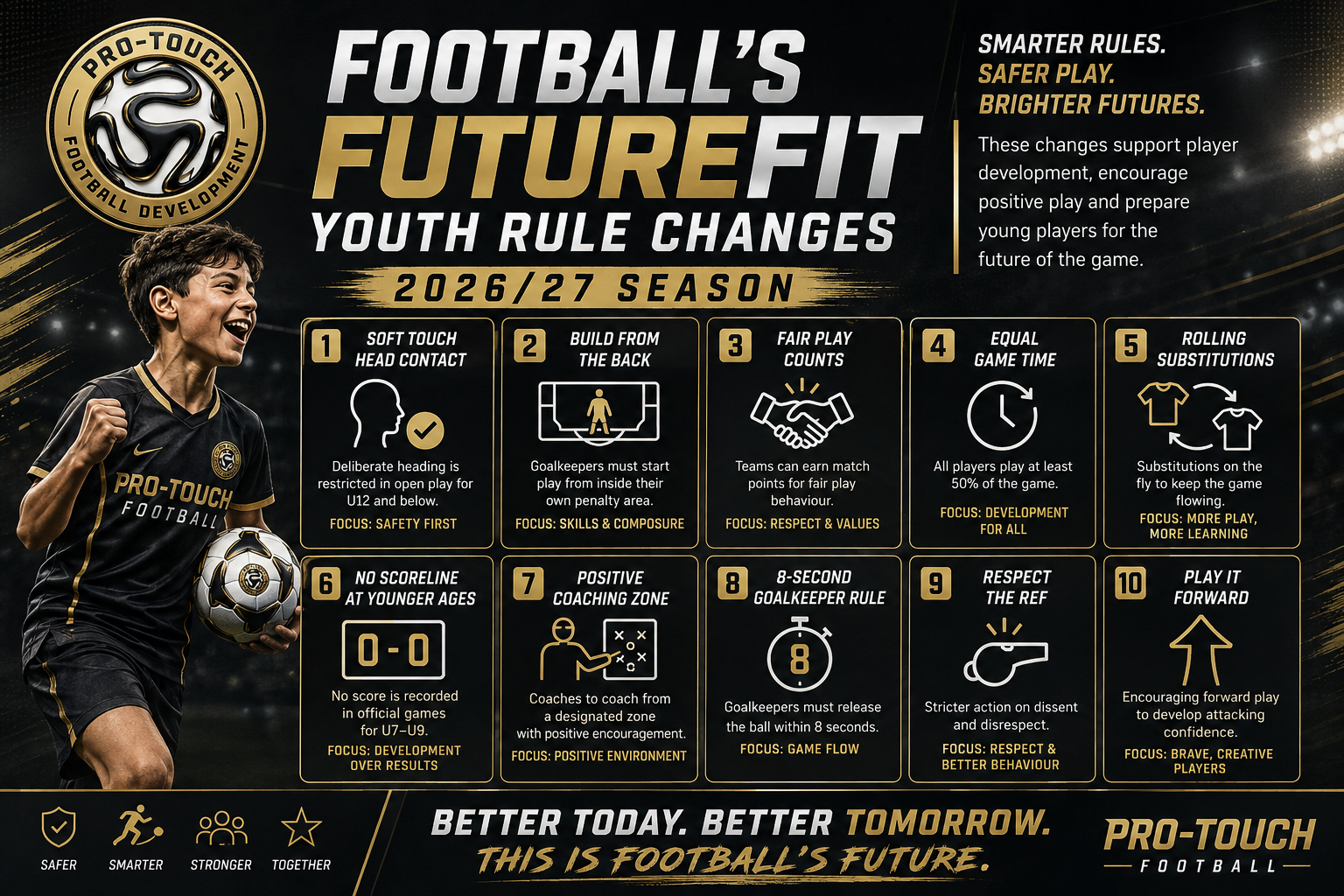
Game Time vs. Team Status: The Real Dilemma Every Young Footballer and Parent Must Face
The Conversation Every Football Family Is Having Right Now
Picture this: your 10-year-old has just been offered a spot on the A-team at their local club. Excitement fills the room until you realise they’ll be the last name on the teamsheet almost every week. Meanwhile, they’ve been playing every minute at the B-team level, scoring goals, making assists, and most importantly, loving every second of it.
Do you chase the badge on the shirt, or do you chase the minutes on the pitch?
This is one of the most common and emotionally charged conversations in youth football today. At ProTouch Football, we work with hundreds of young players and their families each year, and this dilemma comes up again and again. There’s no one-size-fits-all answer but there is a right way to think about it.
Why This Decision Matters More Than Most Parents Realise
Youth football is not the Premier League. The purpose of grassroots and development football is not to win trophies, it is to produce well-rounded, technically capable, emotionally resilient players who grow up loving the game.
When the conversation becomes about status rather than development, something important gets lost. The child. Their experience. Their ownership of their own football journey.
And yet, the pull of the A-team is real. It signals something. To friends. To family. To the child themselves. “I’m good enough.” “I’ve made it.” That feeling matters but so does what comes after it.
How Regular Game Time Actually Develops Young Players
Repetition Is the Foundation of Skill
Every touch of the ball, every decision under pressure, every mistake corrected in real time these are the building blocks of technical development. A young player who plays 60 minutes every Saturday accumulates thousands more repetitions per season than a player who watches from the bench.
This isn’t opinion. It’s how skill acquisition works. Research in sports psychology consistently shows that deliberate practice and active play time are the key drivers of long-term athletic development not the prestige of the squad you belong to.
In a match environment, young players face decisions that training simply cannot replicate: reading the game in real time, managing physical contact, dealing with the emotional highs and lows of competitive football. The only way to develop these instincts is through playing, not watching.
Confidence Is Built on the Pitch, Not on the Bench
There is a particular kind of confidence that only comes from being trusted to play. When a young player knows they will start, knows their coach believes in them, and knows they will have the chance to make an impact, hey play with freedom.
Freedom is where creativity lives.
A child who sits on the bench week after week regardless of how prestigious the squad begins to internalise a quiet but damaging message: I am not quite good enough. Even if that is never said aloud, the experience communicates it clearly.
Contrast this with the B-team player who is a regular starter. They make mistakes, sure. But they also learn how to recover from them. They try new things because they have the space to experiment. Over one or two seasons, this player often overtakes the A-team bench-warmer in terms of technical ability, game understanding, and crucially, love for the game.
What Happens When the Love Dies?
The most painful outcome in youth football is not a player who never makes it to elite level. It is a player who quits.
Dropout rates in youth sport spike during the ages of 11 to 14, and one of the most commonly cited reasons in study after study is lack of enjoyment and lack of playing time. When football stops feeling like something a child chooses, it becomes something imposed on them. That shift, once it happens, is very difficult to reverse.
If the goal is a long career in football even a recreational, lifelong one enjoyment and regular game time are non-negotiables.
What Young Players Actually Feel (But Often Don’t Say)
When we at ProTouch Football speak to young players directly away from parents, away from coaches a consistent picture emerges.
Most of them know exactly which situation they prefer. They want to play. Not just train. Not just be part of a squad. Play.
Many of them also carry a quiet awareness of their parents’ hopes and expectations. The child who sits on the A-team bench is often doing so not because they chose it, but because they sensed that their parent would be proud of the association. This is not a criticism of parents it’s an entirely human dynamic. But it is worth naming honestly.
When we ask young players what they most want from football, the answers are strikingly consistent:
- To play as much as possible
- To improve and feel themselves getting better
- To enjoy it with their friends
- To feel trusted by their coach
Notice what is not on that list: the team’s league position, the status of the squad, the quality of the opposition.
Children are, in many ways, much clearer about what they need than the adults around them. The job of parents and coaches is to listen to that and to be honest about whose ambition is really driving the decision.
The Parent Pressure Problem
Let’s be direct: parent expectation is one of the biggest barriers to healthy youth football development.
This is not about blame. Parents love their children and want the best for them. But in football, “best” is often unconsciously defined as highest status, most elite squad, most competitive environment , when the evidence suggests that for most young players, most of the time, consistent play in an appropriate environment is what actually produces the best outcomes.
The pressure to be on the A-team can manifest in subtle ways:
- Asking a child why they aren’t starting
- Comparing them to teammates who are playing more
- Making the drive home a performance review
- Showing disappointment when a squad selection doesn’t go the way you hoped
None of these are done with bad intentions. But all of them shift the emotional weight of football from the child’s experience to the parent’s expectations. And that weight is heavy.
One of the most valuable things a parent can do is to ask their child — genuinely, without an agenda — “Are you enjoying it?” And then to let the answer actually matter.
Long-Term Benefits of Consistent Game Time Over Team Prestige
The data from professional football academies tells an interesting story. Many elite clubs now specifically seek out players who have had regular game time at junior level, even if that means a lower tier. Why?
Because those players have:
Better decision-making habits formed through thousands of real game situations rather than training drills or bench observations.
Greater emotional resilience they’ve experienced winning and losing, highs and lows, errors and recoveries, all within the context of actual competition.
Stronger intrinsic motivation they play because they love it, not because they’ve been placed in a high-status environment. That internal drive is what sustains elite development over years, not months.
More adaptable technical skills they’ve had to use their technique under pressure, not just in controlled training scenarios.
The late developers players who weren’t the standout stars at under-9 or under-11, but who played consistently and enjoyed their football are frequently the ones who emerge at 16 or 17 as genuinely talented senior players.
Elite football has learned this lesson. Grassroots football is still catching up.
So What Should You Actually Do?
Here is a framework for thinking through this decision — not a prescription, but a set of honest questions to work through:
1. How much will your child actually play? Not theoretically. Not “they say he/she might get some minutes.” Realistically. If the answer is less than half the available playing time, be cautious.
2. Is your child aware of the situation and genuinely choosing it? A 10-year-old who understands the trade-off and wants to try the A-team experience deserves that autonomy. A 10-year-old who is being nudged toward a decision by parental expectation is in a different situation.
3. What does your child look like when they play regularly? Watch their body language, their risk-taking, their smiling. That version of your child is the one who develops.
4. What do they say when you ask them honestly? Ask on a neutral day, not immediately after a match. “If you could choose exactly how your football goes next season, what would you want?” Their answer matters more than you might expect.
5. What is the cost of leaving? In youth football, squad moves are rarely as permanent or as consequential as parents fear. If a season on the B-team leads to more game time, more development, and more joy — that is not a step backward. It may be the best move your child’s football career ever makes.
ProTouch Football’s Approach to Player Development
At ProTouch Football, we believe that every young player deserves a development environment that puts their game, their confidence, and their love for football first.
Our coaching philosophy is built on the principle that consistent, high-quality game time in an appropriate and challenging environment combined with expert coaching is the most powerful development tool available to any young player.
We work with players across all levels, helping them develop technically, tactically, and mentally not by chasing status, but by building genuine footballers who understand the game and love playing it.
If you’re navigating this decision for your child, we’d love to talk. Our coaches work with families every week to find the right environment for each individual player.
Explore Our Development Programmes →
Speak to a ProTouch Coach →
Final Thoughts: The Badge Fades, the Love Doesn’t
Ten years from now, your child will not remember which team badge was on their shirt at under-10 level. They will remember whether they loved football. Whether they felt good at it. Whether Saturday mornings were something they looked forward to or something they dreaded.
That memory that emotional relationship with the game is shaped almost entirely by what happens in these early years. And it is shaped far more by how much they played than by which team they played for.
At ProTouch Football, we’ve seen both sides of this story hundreds of times. The player who chose game time almost always looks back on it as the right call. The one who chose status and rarely played? Often, they’re not playing at all any more.
The game time is the thing. Protect it.
ProTouch Football Development provides elite youth football coaching, development programmes, and expert guidance for players and families across the UK. Visit www.protouchfootball.com to find out more.